
September 16, 2026
Repeatable Grinder Settings Matter More Than Fancy Burrs for Bitter Coffee
If your coffee tastes bitter and your grinder settings feel like a guessing game the burrs may not be the hero. Repeatable adjustment is what keeps you from chasing the same bad cup every morning.
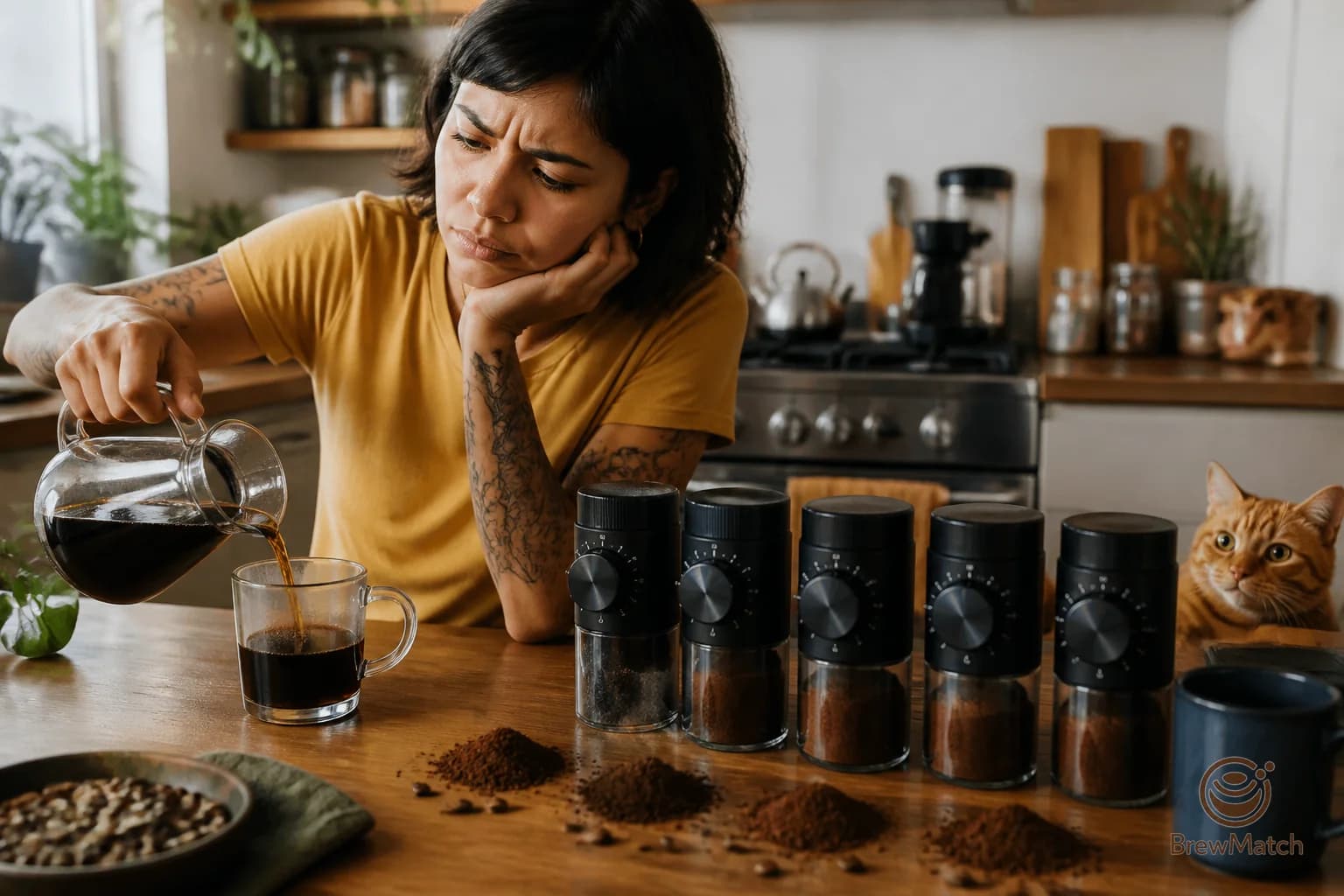
If your coffee tastes bitter no matter where you set the grinder, the problem may not be the burr size, burr shape, or price tag. It may be that your grinder cannot get back to the same setting twice. Repeatable grinder settings matter because bitterness fixes are small. If every adjustment is vague, loose, or hard to track, you are not dialing in coffee. You are guessing with a motor attached.
Your grinder setting is only useful if you can find it again
Most home coffee drinkers are told to grind coarser when coffee tastes bitter. That advice is often right, but it leaves out the annoying part.
Coarser than what?
If your grinder has mushy adjustment, unclear numbers, or a dial that moves when you touch it, you may not know where yesterday's setting was. You make one change, the coffee tastes different, then you try to go back and cannot quite land there again.
That is how people end up blaming the beans.
They buy a smoother looking bag. They switch roast levels. They change the water. Meanwhile the grinder is turning one simple fix into a moving target.
A grinder does not need to be fancy to help with bitter coffee. It needs to make small changes you can repeat.
What repeatable grinder settings actually mean
Repeatable settings do not mean the grinder has more numbers printed on it. A cheap grinder can have plenty of markings and still feel random.
Repeatable means three things:
- You can clearly see where the grinder is set.
- You can move one step or one small amount at a time.
- You can return to a previous setting without guessing.
That is it. Not glamorous. Not the kind of spec that gets dramatic product photos. Still more useful than a lot of grinder marketing.
For bitter coffee, repeatability helps because most fixes are small. You may only need to go a little coarser. If the grinder jumps from too fine to too coarse, your coffee goes from bitter and dry to thin and sour. Then you think coffee is just impossible at home.
It is not impossible. Your adjustment system might just be crude.
If your grinder barely gives you room to move, read A Grinder With Too Few Settings Can Keep Coffee Bitter. Too few usable settings can trap you between bad options.
The bitter coffee pattern this creates
A non repeatable grinder usually creates a specific kind of frustration.
Your coffee tastes bitter on Monday. You move the grinder coarser on Tuesday. Tuesday tastes better, but maybe a little weak. On Wednesday you try to split the difference, but the grinder lands somewhere else. Thursday tastes harsh again. By Friday, you have changed the dose, brew time, water temperature, and your mood.
That is not dialing in. That is symptom chasing.
The tradeoff is simple: a grinder with poor repeatability may still grind coffee, but it makes learning harder. Every cup teaches you less because you cannot trust that one variable stayed in place.
This matters most when you brew drip, pour over, French press, or moka pot at home and want coffee that tastes smooth instead of sharp. You do not need cafe level precision. You need enough control to make one change and know what happened.
If you are not sure whether your bitterness is coming from the grinder, the roast, or your general taste preference, BrewMatch can help you narrow down smoother coffee options without turning your kitchen into a tasting lab.
Fancy burrs do not fix vague adjustment
Coffee grinder marketing loves burr talk. Bigger burrs. Flat burrs. Conical burrs. Steel burrs. Ceramic burrs. It all sounds important because some of it is important.
But for a home coffee drinker trying to make coffee less bitter, burr hype can send you in the wrong direction.
A grinder can have impressive burrs and still be irritating to use. If the adjustment is vague, if the numbers are hard to read, or if the dial drifts, those burrs are not helping you solve bitterness in a practical way.
What people get wrong is assuming the premium part automatically fixes the daily problem. Bitter coffee is usually fixed through control: grind size, dose, brew time, water temperature, and coffee choice. If the grinder makes one of those controls sloppy, the premium spec does not save you.
For a deeper version of that point, see Burr Size Is Not the Coffee Grinder Spec That Fixes Bitter Coffee.
What to look for before buying a grinder
If you are shopping for a grinder because your coffee keeps tasting bitter, do not start with the most dramatic spec sheet. Start with the adjustment experience.
Look for:
- Clear markings you can read quickly
- Small enough steps for your brew method
- A dial or collar that feels stable
- Settings that do not shift during use
- A way to note your usual setting for each brew method
- Enough range for both your current coffee and future bags
This is especially important if you switch between brew methods. A setting that works for drip will not automatically work for French press. Espresso needs much finer control. Cold brew usually wants a much coarser grind.
The grinder does not need to be expensive. It needs to let you make a change on purpose.
A budget grinder with usable, repeatable settings can be more helpful than an expensive grinder that makes every adjustment feel like decoding a safe.
What to test on the grinder you already own
Before replacing anything, run a boring test. Boring is good. Boring saves money.
Pick one coffee. Pick one brew method. Use the same amount of coffee and water for three cups.
Cup one: brew at your current grinder setting.
Cup two: move one small step coarser.
Cup three: move one more small step coarser.
Taste them side by side if you can, or at least write down what changed.
You are looking for a pattern:
- If bitterness drops and sweetness improves, you were probably grinding too fine.
- If bitterness stays but the coffee gets weaker, grind size may not be the main issue.
- If each cup tastes random, your grinder may not be adjusting predictably.
- If you cannot tell which setting you used, the grinder is making troubleshooting harder than it needs to be.
Do not change the beans, filter, dose, and temperature during this test. That is how a simple question turns into a mess.
Practical checklist for less bitter grinder settings
Use this when coffee tastes bitter and you suspect the grinder:
- Write down your current grinder setting before changing it.
- Move slightly coarser, not dramatically coarser.
- Change only one thing per brew.
- Keep coffee dose and water amount the same.
- Check whether the grinder dial feels loose or drifts.
- Notice whether the same setting looks and feels the same tomorrow.
- Avoid judging a grinder by burr marketing alone.
- Favor clear, stable, repeatable adjustment.
- If coffee becomes thin and sour, you probably went too coarse.
- If coffee stays dry and harsh, look at brew time, roast level, and water too.
The goal is not perfection. The goal is to stop making random changes and calling them experiments.
When a new grinder is worth considering
A new grinder may be worth it if your current grinder gives you no useful path between bitter and weak.
That can happen when the grind is uneven, when the adjustment jumps too far, or when the grinder cannot hold a setting. If every cup lands somewhere different even when your recipe stays the same, you are fighting the tool.
But do not buy a new grinder just because coffee tastes bitter once. Darker roasts, too much brew time, too hot water, too fine a grind, and stale coffee can all push bitterness up. The grinder is one suspect, not the whole case.
A smart upgrade is not about buying the grinder with the loudest fan club. It is about buying the grinder that gives you control over the thing you actually need to change.
A simple way to think about it
Less bitter coffee usually comes from better control, not more coffee gear drama.
Repeatable grinder settings give you that control. They let you move coarser when coffee tastes bitter, move back if you overshoot, and compare one cup to the next without rewriting the whole recipe.
Fancy burrs can be nice. Big burrs can be nice. Premium grinders can be nice. But if you cannot make a small adjustment and find it again tomorrow, the grinder is not helping you fix bitter coffee. It is helping you stay confused.
If you want smoother coffee without memorizing grinder specs, try BrewMatch. It matches your taste preferences to coffees that make sense for how you actually drink them.
Find your match
Not sure which beans fit your taste?
Use BrewMatch to turn your flavor goal, brew method, and current coffee problem into a practical roast and bean profile.
Try BrewMatch