
August 10, 2026
Conical vs Flat Burr Grinders Are Not the Bitter Coffee Fix
Conical vs flat burrs sound like the big grinder decision. For bitter coffee at home the less glamorous details usually matter more.
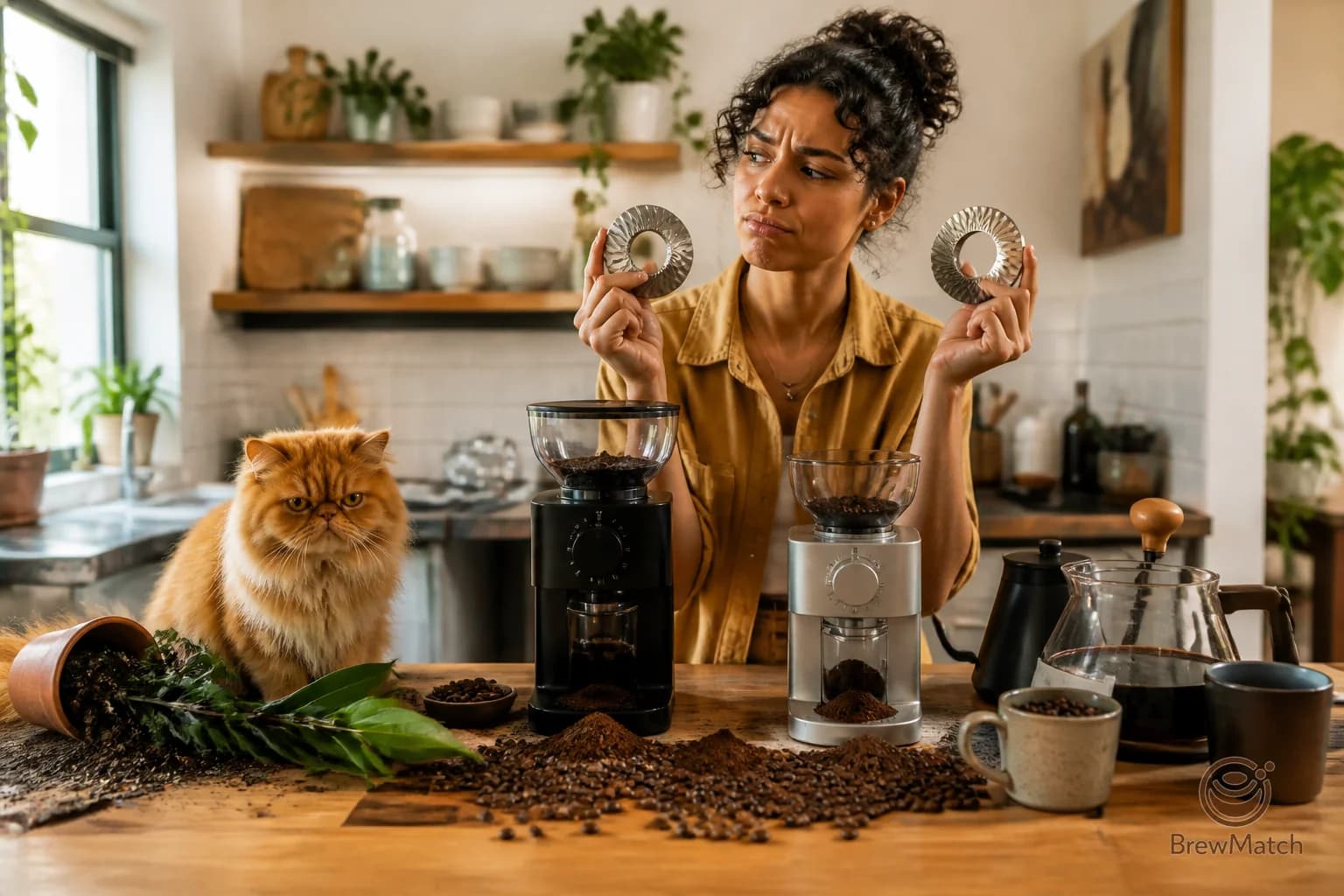
Conical vs flat burr grinders can change how coffee tastes, but burr shape is rarely the main reason your coffee tastes bitter. If your cup is harsh, dry, burnt, or bitter, the bigger issues are usually grind size, grind consistency, too many fines, old grounds, or a recipe that pulls too much from the coffee. Burr shape matters. It just does not deserve the drama it gets.
A lot of grinder shopping advice makes this decision feel like a fork in the road. Pick conical and get one flavor. Pick flat and get another. Miss the right one and your coffee is doomed.
That is not how home coffee works.
What conical and flat burrs actually mean
A burr grinder crushes coffee between two abrasive surfaces. That is already a big step up from chopping beans with a blade grinder, because the goal is more even pieces.
Conical burrs use a cone shaped inner burr and an outer ring burr. Coffee moves through the burrs at an angle. They are common in home grinders because they can be compact, relatively quiet, and easier to fit into lower priced machines.
Flat burrs use two flatter discs facing each other. Coffee passes between them and exits at the edges. They are common in many higher end grinders and commercial setups. People often associate them with clarity, separation, and a more defined cup.
Those descriptions are not fake. Burr geometry can affect particle size distribution, retention, heat, noise, and how the grinder feels to use.
But if your coffee tastes bitter at home, the first question should not be flat or conical. It should be whether the grinder lets you control extraction without fighting you.
Bitterness usually comes from extraction not burr identity
Coffee gets bitter when the brew pulls too much of the harsh stuff from the grounds, or when tiny particles over extract while the rest of the coffee is still catching up.
That can happen with either burr shape.
A flat burr grinder set too fine can make bitter coffee. A conical burr grinder set too fine can make bitter coffee. A fancy grinder with a bad setting can still punish you.
If your coffee tastes bitter and dry, grind size is a better suspect than burr shape. A small move coarser can do more than switching grinder categories. BrewMatch has a deeper guide on this exact problem here: Coffee Ground Too Fine Can Taste Bitter and Dry.
The same goes for over extraction. If the water spends too much time pulling from the coffee, or the grind creates too much surface area, bitterness can creep in fast. For a broader fix, read Over Extracted Coffee Tastes Bitter Not Strong.
The grinder traits that matter more than burr shape
If you are buying a grinder to make coffee taste less bitter, these details usually beat the conical vs flat debate.
Enough adjustment range
A grinder needs enough usable settings for your brew method. This matters a lot for espresso, but it also matters for pour over, drip, AeroPress, moka pot, and French press.
If every setting jump is huge, you might get stuck between sour and bitter. One click is too coarse. The next click is too fine. That is not a burr shape problem. That is an adjustment problem.
For less bitter coffee, you want the ability to move slightly coarser without making the cup thin and empty.
Consistent grinding
No grinder makes perfectly identical particles. Still, better grinders produce a more controlled spread.
The enemy is not just coarse pieces. The bigger bitterness problem is often fines, which are tiny coffee particles that extract very quickly. Too many fines can make a cup taste muddy, harsh, or dry even when your average grind size looks reasonable.
A grinder with decent alignment, stable burrs, and a clean exit path can make dialing in less annoying. You are not chasing random bitterness every morning.
Easy cleaning
Old coffee oils and trapped grounds can make fresh coffee taste stale, heavy, and bitter. A grinder that is miserable to clean will probably not get cleaned often.
That does not mean you need a lab routine. It means the hopper, burr chamber, chute, and catch cup should not feel like a puzzle box.
If two grinders taste similar, buy the one you will actually maintain.
Low retention
Retention means coffee gets stuck inside the grinder after grinding. Some of it may come out later, mixed into a future brew.
That stale leftover coffee can add bitterness and flatness, especially if you switch beans or grind sizes often. Low retention is not just an espresso nerd concern. It helps regular people avoid mystery flavors.
A workflow you will not hate
This sounds soft, but it is not. If the grinder is loud, messy, annoying to adjust, or hard to dose with, you will use it badly or stop using it.
The best grinder for your coffee is not the one that wins an argument online. It is the one that helps you repeat a good cup without turning breakfast into a science fair.
If you want a shortcut that starts with how you want coffee to taste instead of forcing you to decode grinder forums, try BrewMatch. It matches your taste preferences to coffee choices without the snob routine.
When flat burrs might make sense
Flat burr grinders can be a good choice if you care about clarity, brew a lot of pour over, or want more separation between flavors. Some people find that flat burrs make lighter roasts taste more distinct.
That can be great.
It can also be overkill if your main goal is simply less bitterness in a morning cup.
Flat burr grinders can cost more, take up more space, create more noise depending on the model, and sometimes require more careful cleaning. None of that is a dealbreaker. It is just the tradeoff.
If you are brewing mostly automatic drip or French press and you want coffee that tastes round, smooth, and not harsh, a good conical burr grinder may be more than enough.
When conical burrs might make sense
Conical burr grinders are often the practical home choice. They can be smaller, quieter, and more affordable. Many make excellent coffee.
A good conical burr grinder can absolutely reduce bitterness compared with pre ground coffee or a blade grinder because it gives you fresher grounds and better control.
The trap is assuming conical means forgiving. It does not. You can still grind too fine. You can still brew too long. You can still leave old coffee in the burr chamber. You can still buy oily dark beans that clog things up and taste harsher than you expected.
Conical burrs are not magic. They are just a very reasonable tool.
If you are still using a blade grinder
If the real comparison is blade grinder vs any burr grinder, choose the burr grinder first. That change is usually more meaningful than conical vs flat.
Blade grinders chop unevenly. You get boulders and dust in the same batch. The dust over extracts and can taste bitter. The big pieces under extract and can taste sour or hollow. Then people blame the beans.
If that sounds familiar, start with the basics in Burr Grinder vs Blade Grinder for Less Bitter Coffee.
Once you are already in burr grinder territory, then conical vs flat becomes a smaller preference decision.
A practical checklist for buying a grinder to reduce bitterness
Use this before you buy, not after the box is on your counter.
- Pick burr over blade if bitterness and uneven flavor are the problem.
- Make sure the grinder has enough settings for your brew method.
- For espresso, prioritize fine adjustment over burr shape.
- For pour over and drip, prioritize consistency and easy repeatability.
- Check whether the grinder is easy to clean without special tools.
- Look for low retention if you single dose or switch beans often.
- Avoid choosing only by wattage, speed, or influencer hype.
- Do not assume more expensive means less bitter.
- Do not assume flat burrs automatically taste smoother.
- Do not assume conical burrs automatically hide brewing mistakes.
- Buy for your actual routine, not a fantasy version where you weigh beans in silence for 20 minutes.
A simple test before blaming your grinder
Before replacing your grinder, run one boring test.
Brew your normal coffee exactly as usual, but grind one step coarser. Keep the coffee amount, water amount, water temperature, and brew time as steady as you can.
If the cup gets less bitter and less dry, your issue was probably extraction. Your grinder may be fine. Your setting was just too aggressive.
If it gets weak but still bitter, you may have too many fines, stale beans, dirty equipment, or water issues.
If nothing changes, then the grinder may not be giving you meaningful adjustment control. That is when shopping starts to make sense.
Change one thing at a time. Coffee gets confusing fast when you adjust grind size, dose, water temperature, and beans all in the same morning. That is how people end up with six theories and no drinkable cup.
The verdict on conical vs flat for bitter coffee
If you want less bitter coffee, do not make burr shape your first filter.
Choose a grinder that gives you control. Choose one that makes consistent grounds. Choose one you can clean without resentment. Choose one with enough adjustment for how you brew.
Flat burrs can be excellent. Conical burrs can be excellent. Both can make bitter coffee when the grind is too fine, the recipe is off, or old grounds are hanging around inside the machine.
The less glamorous answer is also the more useful one: your grinder should help you make small, repeatable changes. That matters more than winning the conical vs flat debate.
If you want coffee recommendations based on smoothness, bitterness tolerance, roast preference, and how you actually brew at home, use BrewMatch. Better coffee starts with taste, not gear arguments.
Find your match
Not sure which beans fit your taste?
Use BrewMatch to turn your flavor goal, brew method, and current coffee problem into a practical roast and bean profile.
Try BrewMatch