
July 21, 2026
Burr Grinder vs. Blade Grinder for Less Bitter Coffee
Bitter coffee is not always a bean problem. Your grinder might be throwing dust and boulders into the same brew and calling it breakfast.
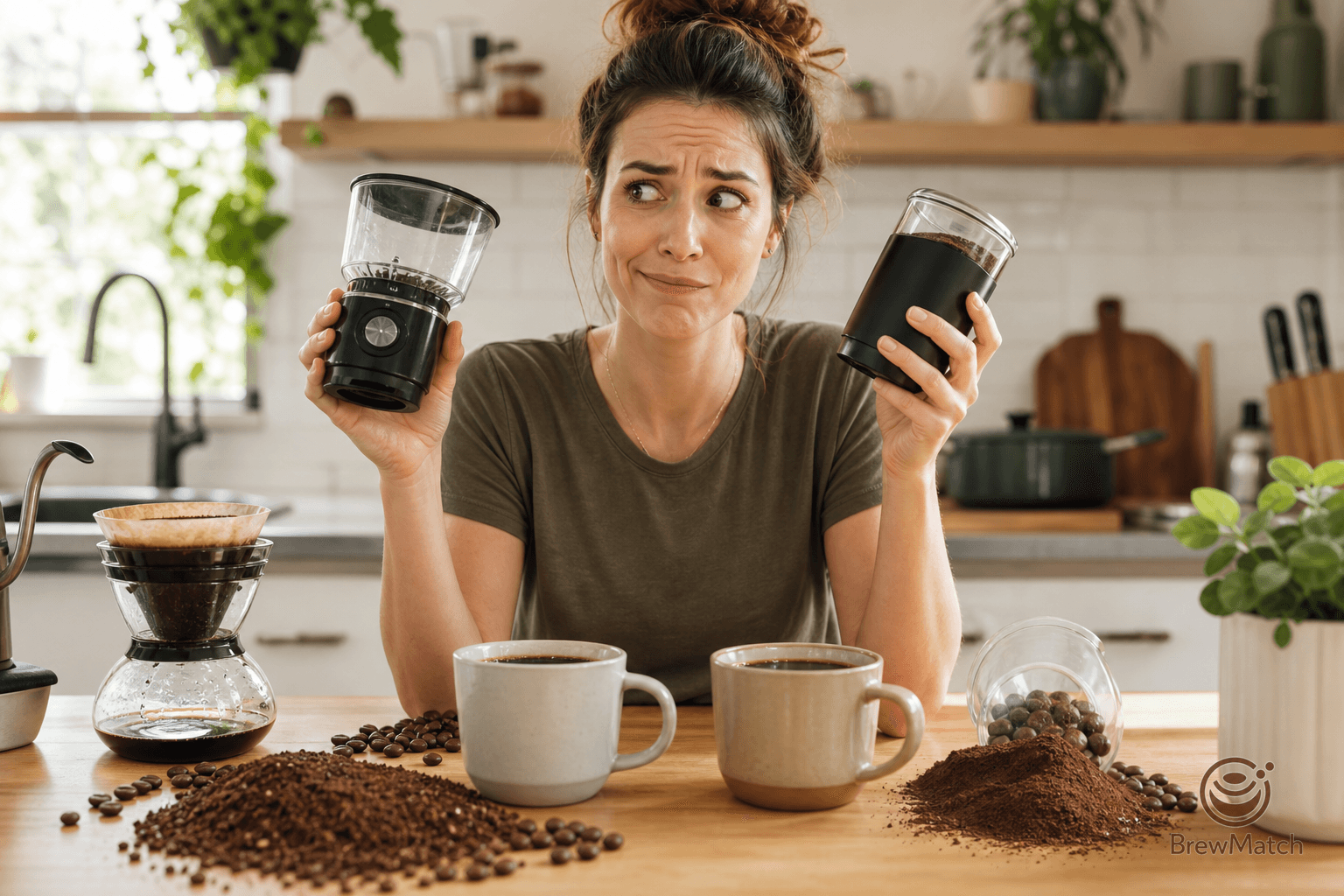
If your coffee keeps tasting bitter, a burr grinder usually gives you a better shot at fixing it than a blade grinder. Not because burr grinders are fancy, but because they make more even pieces. Even grounds extract more predictably. Blade grinders chop beans into a messy mix of powder and chunks, which can make the same cup taste bitter, thin, and confusing all at once.
That does not mean you need to buy the most expensive grinder on the internet. It means you should know what problem each grinder creates before you blame your beans.
The grinder problem hiding in bitter coffee
Coffee bitterness often comes from over extraction. That means water pulled too much out of the coffee grounds, especially the harsher compounds that show up late in brewing.
Grind size has a huge say in that. Smaller particles extract faster. Larger particles extract slower. If your grinder creates both at the same time, your brewer has to deal with two different coffees in one basket.
That is the blade grinder trap.
A blade grinder does not really grind. It spins a sharp blade and smashes beans around until you stop it. Some bits turn into dust. Some stay chunky. The longer you run it, the more dust you make, but the chunky pieces do not magically become uniform.
So your brew can end up with:
- Fine dust that extracts too much and tastes bitter or dry
- Large chunks that extract too little and taste weak or sour
- Muddy body from powder slipping into the cup
- A recipe that changes every morning even if you use the same beans
That is why bitter coffee from a blade grinder can feel so annoying. You can change one thing and still get a weird result, because the grind itself is inconsistent.
For a deeper look at the blade grinder side of the problem, read 5 Blade Grinder Problems That Make Coffee Taste Bitter.
What a burr grinder does differently
A burr grinder crushes beans between two abrasive surfaces. You set the gap between those surfaces, and that gap controls the grind size.
The big advantage is consistency. A burr grinder still creates some fines, because coffee is brittle and imperfect. But it usually creates fewer wild extremes than a blade grinder.
That consistency makes brewing easier because the water is dealing with grounds that behave more like each other. If the cup tastes bitter, you can make a small grind adjustment and expect the next cup to move in a clearer direction.
With a blade grinder, you often end up guessing. Was the coffee bitter because the grind was too fine? Because there was too much dust? Because you ran the grinder too long? Because the big chunks under extracted while the fines over extracted? Yes, possibly all of that. Very helpful, thanks.
A burr grinder does not make bad coffee impossible. It just removes one of the messiest variables.
Blade grinders are not evil
Blade grinders get treated like the villain in coffee advice, which is a bit lazy. They are cheap, small, easy to find, and better than buying pre ground coffee that has been sitting around too long.
The tradeoff is control.
If you drink coffee casually and mostly want caffeine that tastes decent, a blade grinder can be workable. If you are trying to fix bitter coffee, though, it can make troubleshooting harder than it needs to be.
A blade grinder is especially risky for brewing methods that punish fine dust:
- French press, where fines sit in the water and keep extracting
- Pour over, where dust can clog the filter and slow the drawdown
- Drip coffee makers, where uneven grounds can brew harsh and flat
- Moka pot, where too fine a grind can make the cup taste aggressive
If your cup tastes bitter and dry, grind size should be near the top of your suspect list. A Too Fine Grind Can Make Coffee Taste Bitter explains that part in more detail.
When a burr grinder is worth buying
A burr grinder is worth considering if you keep running into the same bitter cup even after changing obvious things like brew time, water temperature, and coffee amount.
It is also worth it if you brew whole bean coffee several times a week. The more often you brew, the more the consistency pays you back. Not in some mystical coffee hobby way. In a very boring and useful way: fewer bad cups before work.
You do not need a premium grinder to get a meaningful upgrade from a blade grinder. An entry level burr grinder can still give you more control than random chopping.
Look for:
- Adjustable grind settings
- A clear way to repeat the same setting
- Burrs instead of blades
- A size that fits your kitchen without becoming counter clutter
- Easy cleaning, because stale coffee dust can taste rough too
Avoid buying based only on the number of settings. More settings can help, but repeatable settings matter more than a giant dial full of vague promises.
If you are deciding whether the grinder is actually the problem, the Grind Size and Grinder Fit Helper can sort grind direction from grinder consistency.
If you are unsure whether your taste problem is the grinder, the beans, or the recipe, BrewMatch can help you narrow it down without turning your kitchen into a tasting lab.
How to make blade grinder coffee less bitter
If you are keeping your blade grinder for now, do not panic. You can still improve the cup.
Try this:
- Pulse instead of holding the button down
- Shake the grinder gently between pulses to move the larger pieces around
- Stop before the coffee turns dusty
- Use a slightly shorter brew time if the cup tastes bitter and dry
- Avoid grinding extremely fine for French press or drip
- Clean old coffee dust out of the grinder regularly
This will not turn a blade grinder into a burr grinder. It can reduce the worst unevenness, though.
The most common mistake is grinding longer to make everything look finer. That often creates more bitter dust while some chunks remain too large. The cup gets harsher, not better.
If your coffee tastes both weak and bitter, that is a classic uneven grind clue. The fines are over extracted. The big pieces are under extracted. Your mouth gets the argument.
How to dial in a burr grinder for less bitterness
If you already own a burr grinder and your coffee still tastes bitter, do not assume the grinder failed. You may simply be grinding too fine for your brew method.
Use taste as the guide:
- Bitter and dry: grind a little coarser
- Harsh and heavy: grind a little coarser or use less brew time
- Thin and sour: grind a little finer
- Bitter but weak: check for uneven extraction, channeling, or stale grounds
Make one change at a time. If you change grind, coffee amount, water temperature, and brew time in the same morning, you will learn nothing except that you are capable of chaos before 8 a.m.
For drip, pour over, and French press, move one or two grinder clicks at a time if your grinder has small adjustments. For grinders with wider steps, make one setting change, taste, and write down what happened.
You are not chasing perfection. You are trying to move the cup away from bitter and toward balanced.
Practical checklist for bitter coffee and grinder choice
Use this before buying anything:
- Does your coffee taste bitter and dry, not just strong?
- Are there dusty particles stuck to the grinder lid or cup?
- Do you see both powder and large chunks after grinding?
- Does your brew time run longer than expected?
- Does pour over drain slowly or stall?
- Does French press coffee taste muddy near the end?
- Does changing the recipe give random results?
- Are you using a blade grinder and trying to troubleshoot bitterness often?
If you answered yes to several of these, your grinder is probably part of the problem.
Use this before upgrading:
- Do you brew whole bean coffee at least a few times a week?
- Do you want repeatable results more than gadget bragging rights?
- Do you have space for a burr grinder?
- Are you willing to adjust grind size instead of using one setting forever?
- Would fewer bitter cups be worth the cost?
If yes, a burr grinder is a sensible upgrade. Not glamorous. Just useful.
The simple verdict
For less bitter coffee, a burr grinder beats a blade grinder because it gives you more even grounds and better control. That makes it easier to fix over extraction instead of guessing your way through bad cups.
A blade grinder can work in a pinch, especially if you pulse, shake, and avoid grinding into dust. But if bitterness keeps coming back, the grinder may be the thing making every other fix harder.
Start with the cheapest experiment: adjust how you grind and brew. If the cup improves but still feels inconsistent, a burr grinder is probably worth it.
And if you want help finding coffee that fits what you actually like, not what coffee people say you should like, try BrewMatch. Bitter coffee is fixable. You just need to stop letting random coffee dust run the show.
Find your match
Not sure which beans fit your taste?
Use BrewMatch to turn your flavor goal, brew method, and current coffee problem into a practical roast and bean profile.
Try BrewMatch