
August 24, 2026
4 Things a Budget Coffee Grinder Needs If You Hate Bitter Coffee
A budget grinder can help bitter coffee taste smoother but only if it gets the boring stuff right. Skip the shiny specs and check these four things first.
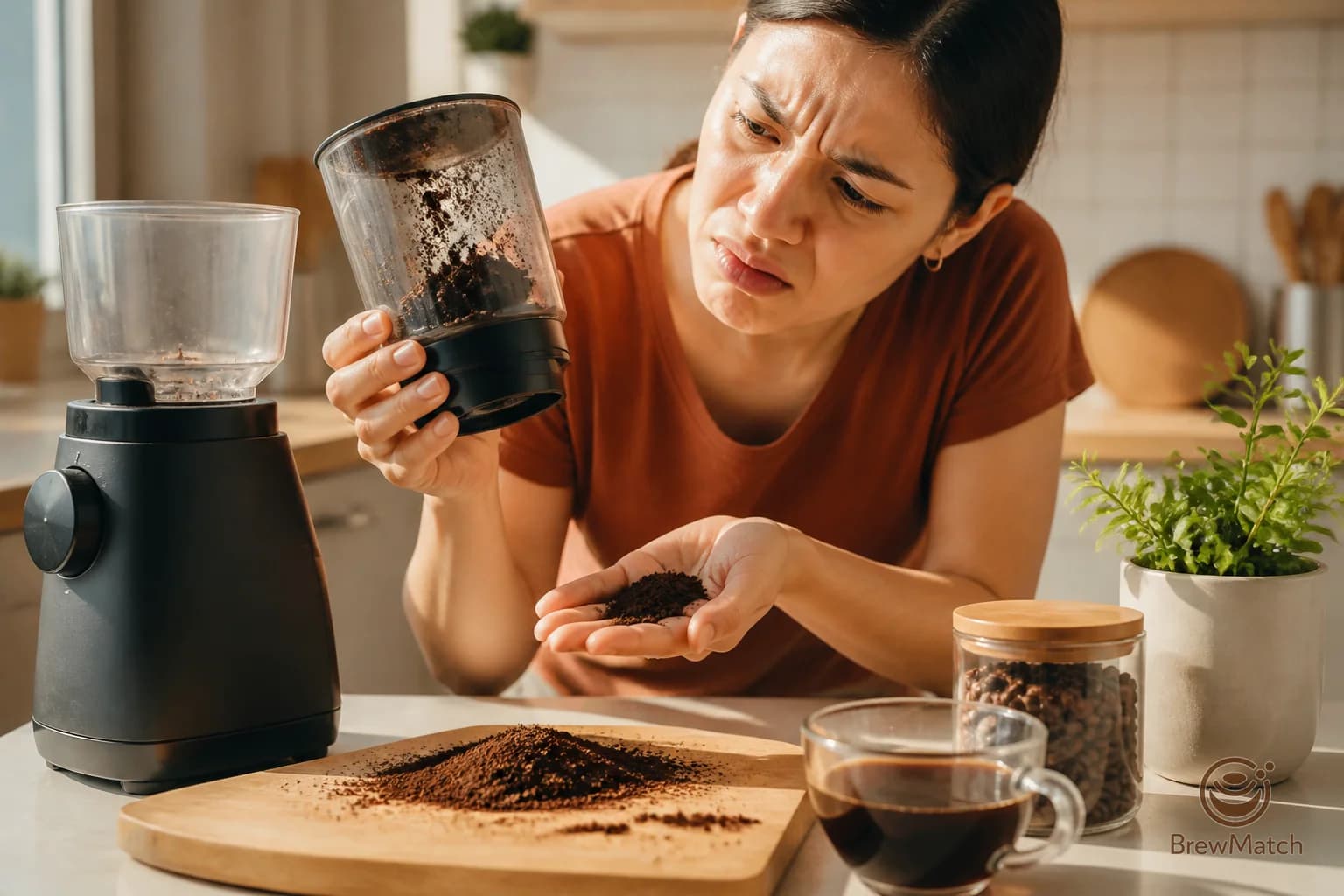
A budget coffee grinder can make coffee less bitter, but only if it grinds evenly enough, gives you useful adjustment steps, does not create a pile of coffee dust, and is easy to clean. A cheap grinder that misses those basics can make good beans taste harsh. The price tag is not the hero. Control is.
If you hate bitter coffee, your grinder needs to do one boring job well: make grounds consistent enough that small recipe fixes actually show up in the cup.
This is where a lot of home coffee drinkers get trapped. They want smoother coffee, so they shop for the grinder with the biggest claims, the most dramatic product photos, or the word espresso slapped on the box. Then their drip coffee still tastes bitter and they assume they bought bad beans.
Sometimes the grinder was the problem. Sometimes the grinder was just the wrong kind of problem.
1. It needs enough grind adjustment to make small fixes
If coffee tastes bitter, one of the first fixes is usually to grind a little coarser. Not wildly coarser. Just a little.
That is where many budget grinders fail. They technically have settings, but the jumps between settings are too large. One click is bitter and dry. The next click is weak and sour. You are stuck choosing which version of bad you dislike less.
For home drip, pour over, AeroPress, moka pot, and French press, you do not need laboratory level control. You do need enough usable range to move gradually.
Look for a grinder that lets you adjust in small enough steps that you can taste a difference without wrecking the cup. If the grinder only has vague labels like fine, medium, and coarse, that is not much help. Labels are not control.
The trap is thinking more settings always means better coffee. Not always. A grinder can have a huge number of settings and still produce uneven grounds. But if you have almost no adjustment, you have almost no way to correct bitterness.
If your current grinder jumps from too fine to too coarse, you may be fighting the machine instead of your recipe.
2. It needs a reasonably even grind
Bitter coffee often comes from uneven extraction. Tiny particles over extract quickly and taste harsh. Larger chunks under extract and taste thin or sharp. Mix enough of both together and you get the classic home coffee insult: bitter but not satisfying.
A budget grinder does not need to be perfect. It does need to avoid making a chaotic mix of powder and boulders.
This is why burr grinders are usually a better bet than blade grinders. Burrs crush coffee through a set gap. Blade grinders chop randomly. You can shake a blade grinder and pulse carefully, but you are still asking a tiny spinning blade to do precision work. It is not built for that.
If you are choosing between a very cheap blade grinder and a modest burr grinder, the burr grinder usually gives you more control. If you want the longer version, read Burr Grinder vs Blade Grinder for Less Bitter Coffee.
That said, do not buy the cheapest burr grinder blindly. Some low cost burr grinders still produce a lot of fines, especially at finer settings. If reviews keep mentioning muddy cups, dusty grounds, or bitter drip coffee, pay attention. Those are not cosmetic complaints. They show up in the cup.
3. It needs to keep coffee dust under control
Coffee dust is not just messy. It extracts fast.
When a grinder creates too many fines, those tiny particles can make coffee taste bitter even if your main grind size looks reasonable. This is especially annoying because you may do the obvious fix, grind coarser, and still taste bitterness. The big particles got coarser, but the dust is still there doing damage.
Budget grinders often cut corners here. Some use weaker motors, wobbly burr alignment, or designs that trap and regrind bits of coffee. You do not need to know every mechanical detail. You just need to know what to look for.
After grinding, check the grounds. Do they look fairly consistent, or do you see a sandy powder coating everything? Is there a fine layer stuck to the bin? Does the brewed coffee leave sludge at the bottom of the cup even when you are using a paper filter?
A little dust is normal. A lot of dust is a bitterness tax.
This is also why an expensive grinder is not automatically the answer. Price can buy better parts, but it does not guarantee the right match for how you brew. A grinder designed around espresso may not be the friendliest option for basic drip coffee. A fancy grinder that is annoying to adjust may not help you make better coffee on a sleepy Tuesday.
If you are comparing upgrades, Expensive Grinders Do Not Automatically Make Coffee Less Bitter is worth reading before you spend more than you planned.
4. It needs to be easy enough to clean that you will actually clean it
Old coffee oils taste stale, sharp, and bitter. Grounds trapped inside the grinder can hang around and mix into tomorrow's brew. That does not make your coffee taste fresher.
A budget grinder can be perfectly useful if you can open it, brush it out, and keep the chute from clogging. A grinder that requires a tiny screwdriver, a prayer, and twenty minutes of patience will probably not get cleaned often.
This is not a moral failing. It is kitchen reality.
Before buying, look at how the grinder comes apart. Can you remove the top burr? Is the grounds path visible? Are there corners where old coffee will collect? Does the bin create static and leave powder everywhere?
The easier it is to clean, the less stale coffee ends up in your cup. That is not exciting marketing copy, but it is one of the differences between coffee that tastes clean and coffee that tastes harsh.
If you are not sure whether your bitterness is coming from beans, grind, water, or dose, BrewMatch can help you narrow down your taste pattern before you buy more gear.
What to ignore when shopping
A lot of grinder shopping advice gets weird fast. You do not need to become a burr geometry person to make better coffee at home.
For bitter coffee, these claims are usually less important than people make them sound:
- Huge setting counts without useful control
- Espresso branding when you mostly brew drip or French press
- Luxury materials that do not fix uneven grinding
- Giant hoppers if you leave beans sitting in them for days
- Touchscreens and timers before grind quality is handled
- Product photos showing perfect grounds with no real user feedback
None of those things are automatically bad. They are just not the first place to spend your attention.
If the grinder cannot produce reasonably even grounds, adjust in useful steps, limit dust, and clean without drama, the extra features are decoration.
A practical checklist before you buy
Use this before you put a budget grinder in your cart.
- Does it use burrs instead of blades?
- Does it have enough adjustment for your brew method?
- Are the settings easy to repeat?
- Do owners complain about lots of fines or muddy coffee?
- Can you remove a burr or access the grind chamber for cleaning?
- Does it grind directly into a bin that is easy to empty?
- Is it meant for the way you actually brew most mornings?
- Are you buying it to fix bitterness, or just because the current grinder annoys you?
That last question is rude but useful.
If your coffee is bitter because you are using too much coffee, brewing too long, using water that is too hot, or grinding too fine, a new grinder may help only part of the problem. If your recipe is chaotic, better equipment can simply make the chaos more repeatable.
The budget grinder test at home
Once you get a grinder, test it calmly. Do not change five things at once.
Start with your normal beans, normal water, and normal coffee amount. Grind at a medium setting for your brew method. Brew one cup. If it tastes bitter and dry, go one or two steps coarser. If it tastes weak and sharp, go a little finer or adjust your coffee dose.
Write down the setting that tasted best. That sounds fussy until you realize it saves you from guessing every morning.
Also check the grounds after a week. If the grinder is already packed with old coffee, clean it. If every cup tastes more bitter over time, stale buildup may be creeping in.
A good budget grinder should make troubleshooting easier. It should not turn coffee into a daily negotiation.
So what should you actually buy?
Buy the simplest burr grinder that gives you useful adjustment, reasonably even grounds, low dust for your brew style, and cleaning you will not avoid.
That may be a modest electric burr grinder. It may be a hand grinder if you brew one cup and do not mind the work. It probably is not the cheapest thing with blades. It also does not need to be the most expensive grinder on the shelf.
The goal is not to own impressive coffee gear. The goal is to make coffee that does not punish you with bitterness before 8 a.m.
If you want help figuring out whether your taste problem points to grind, roast, strength, or something else, try BrewMatch. It is built for home coffee drinkers who want better tasting coffee without pretending this has to be a personality.
Find your match
Not sure which beans fit your taste?
Use BrewMatch to turn your flavor goal, brew method, and current coffee problem into a practical roast and bean profile.
Try BrewMatch